KOI-3617

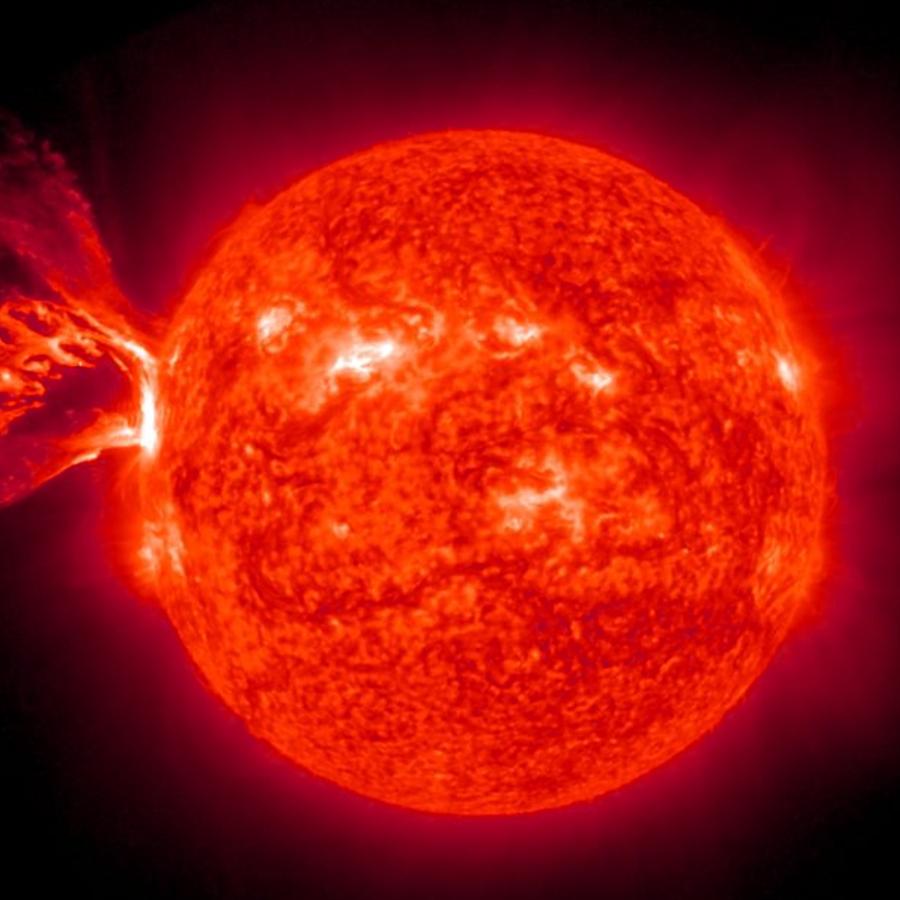
KOI-3617 (also known as KIC 10735564) is a binary star system consisting of a blue-white main sequence star and a “stelloplanet.” KOI-3617 A is roughly twice the size of the sun, while KOI-3617 B is around the same size as our sun. The system is located in the constellation Cygnus, 10,886 light years away. KOI-3617 B was once thought to… Continue reading KOI-3617

EBLM J0555-57 Ab

EBLM J0555-57 Ab is a red dwarf star in the constellation Pictor. It is the smallest known star (that isn’t a brown dwarf, white dwarf or neutron star), with a radius of only 0.08 suns. It has a mass of 290 Saturns, the least massive star known. The star was discovered by astronomers at the University of Cambridge. Astronomical data… Continue reading EBLM J0555-57 Ab

R Doradus

R Doradus (also known as HR 1492 or P Doradus) is a red giant star in the constellation Dorado. It has the largest apparent size as viewed from Earth. R Doradus is also a semiregular variable star. In Infrared light, R Doradus is one of the brightest stars in the night sky, although this does not apply with visible light.… Continue reading R Doradus

Mira

Mira is a red giant star in the constellation Cetus. It is the prototype of the Mira variable star class. Mira also has a companion white dwarf, Mira B. Mira A was the second largest known star in 1925, surpassed by only Antares. Mira A was previously thought to be a red supergiant star but is now known to be… Continue reading Mira

Mu Cephei

Mu Cephei (also known as Erakis or Herschel’s Garnet Star) is a red supergiant star in the constellation Cepheus. It was previously considered a hypergiant star until a new estimate of 762 Solar Radii was published for the star. Its alternative name, Garnet Star, was coined when astronomer William Herschel described its color as garnet red. As it is now… Continue reading Mu Cephei

VY Canis Majoris

VY Canis Majoris (also known as HD 58061 in the Henry Draper catalog) is an extreme red hypergiant star in the constellation Canis Major. It is one of the largest known stars, with a shocking radius of 1,420 times that of the Sun. VY Canis Majoris has been jokingly called “Betelgeuse on Steroids.” It was discovered in 1801 by astronomer… Continue reading VY Canis Majoris

Wolf 1061

Wolf 1061 (also known by its variable star designation V2306 Ophiuchi) is a red dwarf star in the constellation Ophiuchus. It is one of the nearest stars to Earth, with a distance of only 14 Light Years. Wolf 1061 is part of the Wolf dim star catalog, as well as other small stars like Wolf 359. Wolf 1061 has three… Continue reading Wolf 1061

R Horologii

R Horologii is a red supergiant star in the constellation Horologium. It is a Mira-type variable star with a magnitude of 4.7 to 14.3, one of the largest ranges of brightness for any star. It is located only 756 light years away, one of the closest large supergiants. R Horologii shares some traits with Antares and Betelgeuse, two other large… Continue reading R Horologii

V382 Carinae

V382 Carinae (also known as X Carinae) is an extremely rare yellow hypergiant star in the constellation Carina. Yellow hypergiants are extremely rare, with only 20 known ones in our galaxy alone. V382 Carinae is one of the largest stars, with a radius of 616 Solar Radii, nearly on par with Antares, Betelgeuse and R Horologii. V382 Carinae is usually… Continue reading V382 Carinae

Almaaz

Almaaz (better known as Epsilon Aurigae) is a yellow-white supergiant star in the constellation Auriga. It has a smaller blue main sequence star companion, dubbed Almaaz B or Epsilon Aurigae B. Almaaz A is a very historically important star, as in 1940 it was crowned as the largest star, with a radius of 2,400 Solar Radii at the time. It… Continue reading Almaaz