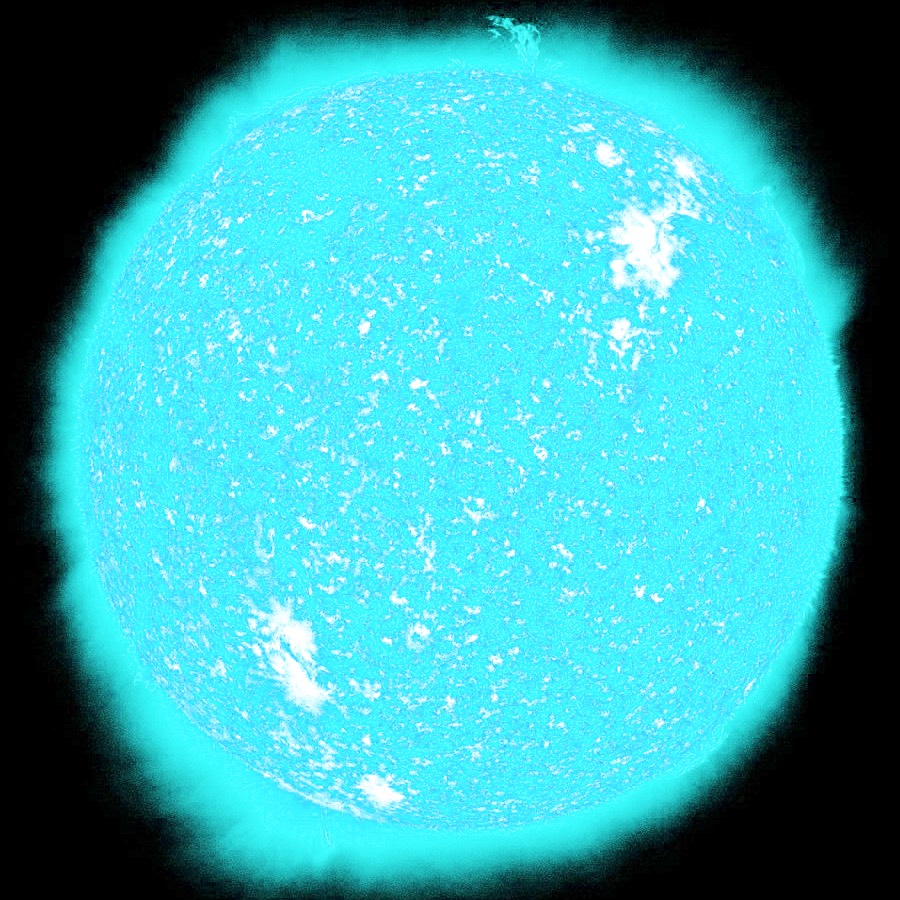
Hamal

Hamal is an orange giant star in the constellation Aries. It is the brightest star in the constellation, and it is the 50th brightest star in the entire night sky. Its name is derived from the shortening of the Arabian term Ras Al-Hamal. It is thought there is a planet orbiting the star. Astronomical data Radius (in Solar Radii): 15.19… Continue reading Hamal

Regulus

Regulus is a blue straggler star in the constellation Leo. it is the brightest star in the constellation Leo and the 21st brightest star in the night sky. The Regulus system is composed of four stars and a brown dwarf. Regulus Aa is a very oblate star, caused by its 15.9-hour rotation period. The name Regulus means ‘little king’ in… Continue reading Regulus

Betelgeuse

Betelgeuse is a red supergiant star in the constellation Orion. It is famous for being one of the largest known stars, with a maximum size of 764 Solar Radii. It is the second brightest star in Orion, however its brightness fluctuates over time. In 2019, Betelgeuse experienced a Great Dimming event similar to other stars. Betelgeuse is arguably the largest… Continue reading Betelgeuse

Castor

Castor is a white main sequence star in the constellation Gemini. it is the second brightest star in said constellation, although its Bayer designation is α Geminorum. It is a 6 star system, Composed of two white main sequence stars and four red dwarf stars. The two components of Castor C are also known as YY Geminorum. Astronomical data Castor… Continue reading Castor

Pollux

Pollux is an orange giant star in the constellation Gemini. It is the brightest star In said constellation, Although it is given the Bayer designation β Geminorum. Pollux, along with Castor are named after the twins in Greek and Roman mythology, hence the two stars’ origin constellation. Pollux is the nearest giant star to the sun. It is said that… Continue reading Pollux

Sirius

Sirius is a blue-white main sequence star in the constellation Canis Major. It is the brightest star in the night sky. Its name means ‘Scorching’ in Greek. The Sirius system Is composed of two stars, a blue-white main sequence star and a white dwarf. The white dwarf is smaller than Earth, while the main sequence star is at least twice… Continue reading Sirius

Aldebaran

Aldebaran is a red giant star in the constellation Taurus. It is known for being located near the Hyades star cluster, although it is older and not a member. It is the fourteenth brightest star in the night sky and the brightest star in the constellation Taurus. It was recently found that Aldebaran may have a companion star, a small… Continue reading Aldebaran

Arcturus

Arcturus (also called Svati or very rarely Arktur) is an orange giant star in the constellation Boötes. it is the brightest star in the Constellation Boötes as well as the entire northern hemisphere, and the fourth brightest star In the night sky. It has exhausted the supply of hydrogen in its core, thus moving off the main sequence. It is… Continue reading Arcturus

V354 Cephei

V354 Cephei is a red supergiant star in the constellation Cepheus. It is known for its reddish-orange hue and extreme proportions. That said, it Is one of the largest known stars. It is located near the Cepheus OB1 Stellar Association. It was given a size estimate of 2,115,840,000 kilometers in 2005, now an outdated measurement. Astronomical data Radius (in Solar… Continue reading V354 Cephei

Stephenson 2-18

Stephenson 2-18 (also called Stephenson 2 DFK 1 or RSGC2-01) is an extreme red hypergiant star in the constellation Scutum. It Is very commonly incorrectly touted as the largest star ever discovered, for a 2020 estimate inaccurately placed its size at 2,150 Solar Radii, which a star that big literally cannot exist. It is one of the most luminous stars… Continue reading Stephenson 2-18